See Julie Connor’s July 12, 2022, Between the Covers Live TV interview.

Dennis Carnes | March 30, 2020
Five times during his address to the nation on the evening of March 16 bug-eyed French President Emmanuel Macron declared emphatically, “Nous sommes en guerre! ” (We are at war!) Did he intentionally choose the day after the Ides of March, when in 44 BC Roman senators killed Julius Caesar, to speak to us? Macron proclaimed that an insidious and terrifying invader had landed on our shores, bent on nothing less than changing French life as we have lived it. He balanced his call to arms with hope, cheering us on by invoking the uniquely French disposition for resolve and perseverance, poorly honored in this American’s fumbling attempt to perfect the Gallic shrug.
France, after all, is a nation of people who starved during the Nazi occupation, subsisting on grass soup, who took to the streets with their boney arms to thrust bread, cheese, and wine into the hands of their well-nourished Allied liberators. They kissed those weary soldiers with lips reddened with color from rose petals. Marie, Emmanuel, Jean-Marie, the bells of Notre-Dame de Paris—all rang out messages of joy and celebration.
Macron ended his address with “Liberté, égalité, fraternité! ” He had struck just the right balance between alarm and confidence.
Macron promised to aid businesses and citizens alike. He suspended all utility bills, closed the schools, and ordered all non-essential businesses to close. He mandated that we stay in our homes and not leave them without carrying a form certifying that we were out only to buy necessities, to exercise, or to help others.
Cable TV company L’Orange offered its pay-for-view channels free of charge. L’Indépendant, the regional newspaper, expanded its puzzle section.
Gretchen and I had left Houston on February 29, and now we faced these alarming developments only three days after arriving in Laroque des Albères, our adopted village in the Languedoc area of France. Our dear friends, with whom we own our house in the middle of the village, had left it Dutch clean and chock full of food, so at first we had set about filling our French neighbors and friends in on our doin’s since we had last seen them.
We looked forward to joining the St. Patrick’s Day shenanigans at Café des Artistes, the most popular café in town, presided over by the Irishman Ferghill, his English wife Melanie, and their now grownup daughter, who moves effortlessly between English, French, and Catalan. We planned to schedule dinners at Casa Lily, where we relish not only Lily’s food but also her pen-and-ink creations, two of which adorn the walls of our house. And we had chosen a date for dining at Côté Saisons, the Michelin-recognized restaurant a short, lovely stroll from our front door.
Most of all, we looked forward to the meals we had booked in Michelin-starred restaurants in Lyon, a five-hour drive north, where you can find the best food in France. Gretchen planned to help her college roommate and her friend drive the friend’s new BMW to Zürich, from where the friend would ship it to the United States. Gretchen and I would then meet in Lyon. I would take a train from Argelès sur Mer, eight km. east of Laroque, and Gretchen would take a train from Zürich. We love traveling on European trains and take them whenever we can.
We used to travel through Europe with my mother when she was in her sunset years. She loved to chat people up. She could learn more about her Dutch seat mate and the seat mate’s family during a 20-minute ride on an Amsterdam commuter train than a pair of CIA agents could discover in a week, even though mom and her seat mate did not share a common language.
Trains are romantic. Omar Sharif and Julie Christie huddled on a train through Siberia in Dr. Zhivago; in the movies, tearful young women wave goodbye to their sweethearts departing to the front on troop trains and then leap into their arms when they return; unrequited lovers stand alone on train platforms; Humphrey Bogart and Ingrid Bergman struggled through the crush of fleeing Parisians in the train station in Casablanca. There’s something about Sherlock Holmes saying, “Quick, Watson, we’ll just have time to catch the 3:45 from Paddington!” that makes me smile.
We love trains so much we name them: the 20th Century Limited, the Eurostar, the Orient Express, the Hiram Bingham to Machu Picchu. Perhaps George Gershwin delivered the best homage to train travel when he composed “Rhapsody in Blue” on a train, drawing inspiration for the piece’s opening clarinet riff from the train’s whistle and mimicking the train’s lurching and jostling in its syncopation. Paul Theroux’s 1975 book, The Great Railway Bazaar, is a classic of travel writing. Theroux recounts his four-month journey from London through Europe, the Middle East, India, and then back home again on the Trans-Siberian Railway. To ride a train from Italy to Sicily, you wait in your carriage while railroad workers decouple the train, load the cars onto a ship, and then recouple the train when the ship reaches Sicily. Self-driving cars, you say? They’re called trains for goodness sakes.
We adore train stations too. Ride the Moscow underground just to marvel at the dazzling, gilded stations, throwbacks to Tsarist excess. As you gape at the magnificent paintings in Paris’s Musée d’Orsay, remember that you are in a former train station. Make time when you’re in Paris to enjoy a meal in the spectacular Le Train Bleu restaurant with its breathtaking Belle Époque décor, upstairs in Le Gare de Lyon rail station.
After Macron spoke, Gretchen’s college roommate and her friend canceled their trip to Europe, and we knew we would not be going to Lyon.
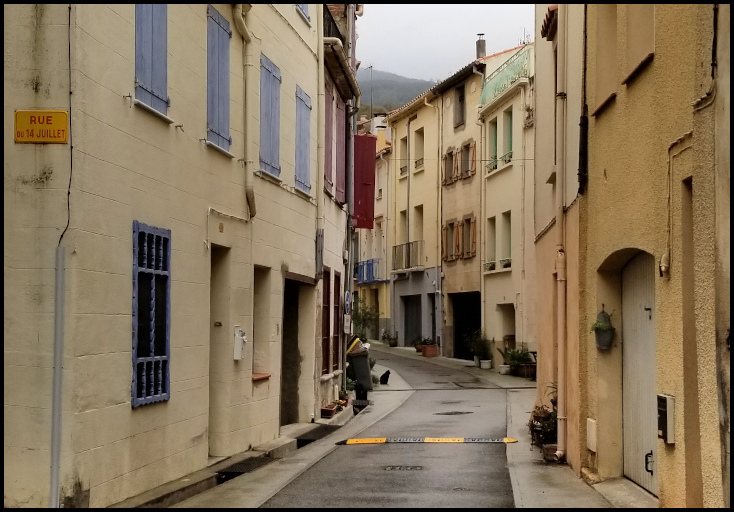
We witnessed dramatic changes at home in Laroque. The cafés closed, the houses remained shuttered, music ceased flowing through open windows, and the smell of burning grape vine prunings no longer wafted into town from the vineyards. Even the neighbors’ dog Pepsi fell quiet, failing to bark at me when I left to go shopping.
Laroque usually rumbles. It whirs and whirls. It rattles with trucks going to job sites in the ancient village above our house. It growls with workers hurrying in diesel-engine cars to work in nearby towns. It screeches with teenagers riding skateboards to school bus stops. Espresso makers spit in its cafés. Now all was silent. The old men abandoned their colloquies in the community garden just when spring was bursting into glory, leaving the fruit trees sagging from their unpicked delights. The locks on their toolsheds lay undisturbed against the wooden doors. Was I mistaken that the bell of Église Saint-Félix no longer announced each hour? No one passed me on the street to say “Bonjour, monsieur,” nor could I return the pleasantry.
I couldn’t avoid thinking that I was in the lost colony of Roanoke, to which Governor John White returned in 1790 after a re-provisioning trip to London. He was shocked to arrive at a deserted island. The colony’s inhabitants, including his granddaughter, Virginia Dare, the first Englishwoman born in America, had vanished. I thought about writing “Croatoan” on a sign, mysteriously, as the Virginia colonists had done.
Or was I in Miletus, the greatest of Greek cities in the 5th century and the birthplace of Thales, one of the seven great mathematicians and philosophers of ancient Greece? The city’s inhabitants abandoned it as the Meander River slowly silted its bay, leaving only the mosquito-infested swamp you see there today.
But then something happened to break my reveries. It started when a neighbor opened a new, cardinal-red umbrella on her terrace. Was she expressing defiance, love, the joy of life? And I heard the bell from Saint-Félix again. The mourning doves melodically awakened us. What a thrill when we gathered in the street with our neighbors, no closer than ten meters to each other, smiling and laughing! And someone was filming all this with her phone. Within an hour, her video had traveled 4,000 miles via Facebook to our friends in America.
I joined other Rocatins (inhabitants of the Laroque des Albères) to shop every morning, standing in line ten meters apart, masked and gloved, waiting until the shop was vacant before we entered, one at a time. Darice and Rene at L’Epicerie greeted me every morning, “Bonjour, Denis! Ca va? ” I answered them with the same good cheer. Darice tempted me with fresh, new eggs from Argelès, which I declined—but I couldn’t resist the sweet strawberries, also on offer. Darice wrapped some chocolates and dropped them into my bag, winking, “Pour vous et votre femme” (for you and your wife).
Now, at 8:00 every night, people march down the street, cheering and applauding the medical personnel. We and our neighbors lean out of our upstairs windows and join in.
As I write this, our neighbor Christine brings over banana bread baked by her husband, Guy. We will enjoy it with our breakfast tomorrow.
Sure, things are difficult. But we don’t complain. We still find time to say “Bonjour” and “Bonne journee.” We stand in line patiently, nodding and smiling to each other. We put up with the bare shelves in our shops and supermarkets and their shortened hours, although we miss our Wednesday market.
The best vaccine, the best tonic, the best protection against the coronavirus, is the human spirit. In tiny Laroque des Albères we celebrate that spirit. We live it.
— Email comments to Julie@bayoucitypress.com or leave public comments below.
Contact us if your comment or reply won’t post.